
I remember the first time I got truly bored with my AI image outputs. Every portrait looked the same, every landscape had that same glassy, over-sharpened quality that screamed: “AI made this.” Then one afternoon, I typed the words “oil painting style” at the end of a prompt almost by accident, and the result stopped me cold. Same subject, completely different feeling. That one experiment sent me down a rabbit hole of testing AI art styles for weeks, and honestly, I am still going.
Whether you are using Midjourney, ChatGPT image generation, or another AI image generator, the style words you add can completely transform your results. Here is what I have actually found works.
Realistic and Photography AI Art Styles
These styles work best when you want your image to pass for something a real camera captured.
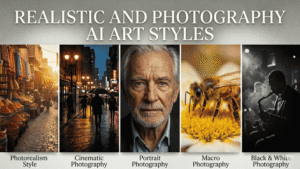
Photorealism Style
Crisp, detailed, and true to life. This style mimics high-resolution digital photography with natural lighting and accurate textures.
Example prompt: “A street market in Marrakech at golden hour, photorealism style, 35mm lens”
Cinematic Photography
Think movie stills. Moody lighting, dramatic composition, and a slight color grade that feels like a frame pulled from a film.
Example prompt: “A woman waiting alone at a rainy bus stop, cinematic photography style, shallow depth of field”
Portrait Photography
Focused on faces with flattering light and fine skin detail. Great for headshots or character concepts.
Example prompt: “A weathered fisherman looking out to sea, portrait photography style, natural window light”
Macro Photography
Extreme close-ups where tiny details become the whole world. Works beautifully for nature, food, and textures.
Example prompt: “A honeybee covered in pollen, macro photography style, soft bokeh background”
Black and White Photography
Classic monochrome with strong contrast and emphasis on shadow and light. Adds instant drama.
Example prompt: “An empty jazz bar after closing time, black and white photography style, high contrast”
Anime and Cartoon AI Art Styles
These are some of the most fun to experiment with, and they also tend to respond really consistently to prompts.
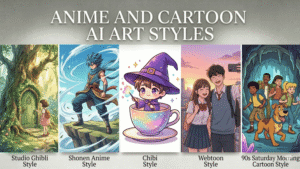
Studio Ghibli Style
Soft watercolor-like backgrounds, expressive characters, and that dreamy, nostalgic quality you know the moment you see it. One of the most reliable art style prompts I have tested.
Example prompt: “A young girl discovering a hidden door in a forest, Studio Ghibli style, soft morning light”
Shonen Anime Style
Bold lines, high energy, dynamic poses, and bright saturated colors. Perfect for action scenes and character sheets.
Example prompt: “A teenage warrior with wind powers standing on a cliff, shonen anime style”
Chibi Style
Small-proportioned, oversized heads, and super cute expressions. Great for character illustrations and stickers.
Example prompt: “A tiny wizard casting a spell from inside a teacup, chibi style”
Webtoon Style
Clean flat coloring with soft shadows is very popular in Korean webcomics. Has a polished, modern look.
Example prompt: “Two friends laughing on a rooftop at sunset, webtoon style”
90s Saturday Morning Cartoon Style
Thick outlines, flat colors, expressive faces. Evokes a strong sense of nostalgia without trying too hard.
Example prompt: “A team of adventurous kids with a talking dog, 90s Saturday morning cartoon style”
Painting and Traditional AI Art Styles
This is where things get really interesting for anyone who wants AI images that look like they came off a museum wall.
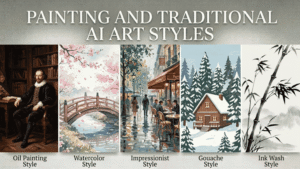
Oil Painting Style
Rich, textured brushwork with deep shadows and luminous highlights. Feels timeless and classical.
Example prompt: “A nobleman’s portrait in a dimly lit library, oil painting style, Dutch Golden Age”
Watercolor Style
Soft edges, transparent washes of color, and a light, airy feel. Works especially well for nature scenes.
Example prompt: “Cherry blossoms falling over a wooden bridge, watercolor style, pastel palette”
Impressionist Style
Loose brushstrokes that capture light and mood rather than precise detail. Think Monet, but yours.
Example prompt: “A busy Paris cafe on a rainy afternoon, impressionist style”
Gouache Style
Flat, opaque color blocks with minimal shading. Very popular right now in illustration and editorial work.
Example prompt: “A cozy cabin surrounded by pine trees in winter, gouache style”
Ink Wash Style
Inspired by traditional East Asian brush painting. Bold, simple strokes and a lot of negative space.
Example prompt: “A lone bamboo stalk bending in the wind, ink wash style”
A personal note here: The gouache style completely caught me off guard. I expected it to look flat and boring, but the results were stunning every single time. It has become my go-to when a client wants something that feels handcrafted without being too painterly. I initially avoided it because I confused it with basic vector art. Do not make that mistake.
Futuristic and Sci-Fi AI Art Styles
Great for concept art, world-building, or just making your desktop wallpaper look incredible.
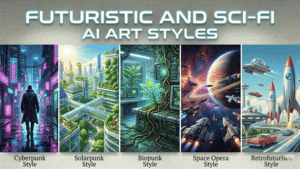
Cyberpunk Style
Neon lights against dark rainy streets, holographic signs, and an urban grit that feels both flashy and dangerous.
Example prompt: “A hacker in a trench coat walking through a neon-lit alley, cyberpunk style”
Solarpunk Style
The optimistic alternative to cyberpunk. Lush greenery woven into futuristic architecture, bright and hopeful.
Example prompt: “A solar-powered city with rooftop gardens and glass bridges, solarpunk style”
Biopunk Style
Organic technology, mutated biology, and a somewhat unsettling fusion of nature and science. Unusual but striking.
Example prompt: “A laboratory where plants have grown through broken computers, biopunk style”
Space Opera Style
Epic scale, dramatic lighting, massive ships, and alien worlds. Think classic sci-fi book covers.
Example prompt: “A fleet of starships approaching a ringed planet, space opera style, dramatic lighting”
Retrofuturism Style
The future as imagined in the 1950s and 60s. Rocket ships, bubble helmets, and optimistic chrome everything.
Example prompt: “A family in matching silver suits boarding a flying saucer, retrofuturism style”
Vintage and Retro AI Art Styles
These styles are incredibly popular right now, and they are a lot of fun to mix with modern subjects.
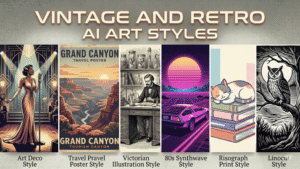
Art Deco Style
Geometric patterns, bold symmetry, gold and black palettes. Elegant and precise.
Example prompt: “A jazz singer on stage in a 1920s ballroom, art deco style”
Vintage Travel Poster Style
Flat color illustration with bold typography energy. Looks like it belongs in an old train station.
Example prompt: “The Grand Canyon at sunrise, vintage travel poster style, muted color palette”
Victorian Illustration Style
Detailed crosshatching and engraving-like linework. Gives any image an antique book feel.
Example prompt: “A scientist examining strange specimens at her desk, Victorian illustration style”
80s Synthwave Style
Purple and pink neon grids, chrome text, sunsets over endless highways. Pure retro aesthetic energy.
Example prompt: “A sports car speeding down a desert road at night, 80s synthwave style, neon grid background”
Risograph Print Style
Layered flat colors with a slightly misaligned offset printing effect. Trendy, quirky, and very distinctive.
Example prompt: “A cat sleeping on a stack of books, risograph print style, two-color palette”
Linocut Style
Bold graphic shapes that look hand-carved from a woodblock. Strong contrast and visible texture.
Example prompt: “An owl perched on a bare branch against a full moon, linocut style”
Mistakes People Make With Style Prompts
After spending a lot of time testing Midjourney styles and ChatGPT image prompts, I keep seeing the same errors.
Stacking too many styles at once is the biggest one. Writing “oil painting, watercolor, impressionist, cyberpunk anime style” in a single prompt confuses the model. You end up with a muddy result that commits to nothing. Pick one primary style, maybe one supporting descriptor, and leave it there.
Forgetting to describe the actual subject is surprisingly common. A prompt that just says “cyberpunk style, dramatic lighting” gives the AI nothing to work with beyond the mood. You still need a clear subject. “A young engineer surrounded by glowing wires, cyberpunk style, dramatic lighting” gives it a starting point.
Misspelling style names matters more than you would think. Writing “gaushe” instead of “gouache” can produce noticeably weaker results because the model pattern matches the exact style vocabulary.
Skipping lighting and mood descriptors is another missed opportunity. Even simple additions like “soft morning light” or “dramatic shadows” can be the difference between a flat image and something that actually has atmosphere.
The real joy of working with AI art styles is experimentation. Take one subject, run it through five different styles, and see what happens. You will be surprised how completely the same prompt transforms when you swap “watercolor style” for “linocut style.” That surprise is where all the fun lives.