
In recent years, 5G has become a popular topic everywhere. Mobile companies, smartphone brands, and even ads keep talking about how fast and powerful it is. But many people still wonder what the real difference is between 4G and 5G, and whether it is worth upgrading.
If you use your phone daily for WhatsApp, YouTube, social media, or gaming, understanding this difference can help you make better decisions. In this guide, we’ll break everything down in simple, easy-to-understand language so you can clearly see how 4G and 5G compare in real life.
Whether you’re streaming videos, chatting online, or using apps, keeping your phone secure is important. For example, you can also check out our guide on Best Clock Lock Apps for Android in 2026 to protect your apps and data.
What is 4G Technology?
4G means the fourth generation of mobile network technology. It was introduced around 2010 and quickly became the standard for smartphones worldwide.
Before 4G, mobile internet was quite slow. With 4G, everything changed.
Key improvements of 4G:
- Faster internet browsing
- Smooth video streaming (HD quality)
- Better call quality (VoLTE)
- Improved app performance
Example:
With 4G, you can easily watch YouTube videos in HD, scroll Instagram without lag, and download apps within seconds.
Even today, 4G is reliable and widely used in most areas.
What is 5G Technology?
5G is a newer and faster type of mobile network. It is designed to be faster, smarter, and more efficient than 4G.
Unlike previous networks, 5G is built to handle not just smartphones but also smart devices like IoT gadgets, smart homes, and even connected cars.
What makes 5G special?
- Extremely high speeds
- Lower delay (latency)
- Better support for multiple devices
- More stable connections in crowded areas
Example:
With 5G, you can download a full HD movie in seconds or play online games with almost no lag.
4G vs 5G: Speed Comparison
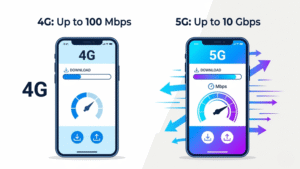
Speed is one of the biggest differences between 4G and 5G.
4G Speed:
- Average: 20–100 Mbps
- Good for streaming, browsing, and normal usage
5G Speed:
- Average: 100 Mbps to 1 Gbps (or more)
- Much faster downloads and uploads
Real-life comparison:
- Downloading a 1GB movie:
- 4G: 3–5 minutes
- 5G: Less than 30 seconds
- Streaming videos:
- 4G: Smooth HD streaming
- 5G: Ultra HD (4K) with no buffering
Simple takeaway:
5G is significantly faster, especially for heavy users.
4G vs 5G: Coverage and Availability
While 5G is impressive, coverage is still growing.
4G Coverage:
- Available almost everywhere
- Works well in cities and rural areas
- Stable and reliable
5G Coverage:
- Mostly available in major cities
- Limited in rural or remote areas
- Still expanding
Example:
If you live in a big city, you might already have 5G. But in smaller towns, your phone may switch back to 4G most of the time.
Important point:
Even with a 5G phone, you’ll still rely on 4G where 5G is not available.
4G vs 5G: Battery Usage
Battery life is another important factor when comparing 4G vs 5G.
4G Battery Usage:
- More stable and optimized
- Uses less battery
- Works efficiently on older phones
5G Battery Usage:
- Can consume more battery
- Uses advanced technology that requires more power
- Newer phones are optimized for better efficiency
Example:
If you keep 5G turned on all day, your battery may drain faster compared to using 4G.
Tip:
You can switch to 4G mode when you want to save battery.
Benefits of 5G Over 4G
Here are the major advantages of 5G:
- Faster speeds: Download and upload data much quicker
- Better gaming: Low lag makes online gaming smoother
- Improved streaming: Watch 4K videos without buffering
- More connections: Works well even in crowded places
- Future-ready: Supports new technologies like smart devices
Example:
If you enjoy online gaming like PUBG or streaming Netflix, 5G can significantly improve your experience.
Do You Really Need 5G Right Now?
Many users ask this question.
You may need 5G if:
- You are in an area where the 5G signal is strong.
- You download large files frequently
- You play online games
- You stream high-quality videos
You may not need 5G if:
- Your 4G connection already works fine
- You mostly use WhatsApp, Facebook, or light browsing
- You are in a place where the 5G signal is weak.
Example:
If you only use your phone for chatting and social media, 4G is still more than enough.
Future of Mobile Networks
Mobile technology is always evolving, and 5G is just the beginning.
What to expect in the future:
- Faster and more stable 5G networks
- Better coverage in rural areas
- Smart cities with connected devices
- Improved online gaming and streaming
- Development of 6G in the coming years
Example:
In the future, you might see self-driving cars, smart homes, and advanced healthcare systems powered by 5G.
How to Know if Your Device Works with 5G
Not sure if your phone supports 5G? Don’t worry, it’s very easy to check, even if you’re not a tech expert. Here are some simple ways to check:
1. Check in Phone Settings
- Open Settings on your phone
- Go to Network & Internet or Connections
- Tap on Mobile Network
- Look for options like 5G / 4G / 3G / 2G
If you see a 5G option, your phone supports it.
2. Search Your Phone Model Online
- Go to Google
- Type your phone model name (for example: “Samsung Galaxy A52 5G specs”)
- Check the specifications section
You’ll quickly find out if 5G is supported.
3. Check the Box or Official Website
If you still have your phone box or can visit the brand’s website, look for “5G” in the features list.
👉 If your phone doesn’t show any 5G option, it likely supports only 4G.
Conclusion
When comparing 4G vs 5G, the main difference comes down to speed, performance, and future potential. 4G is still reliable, widely available, and perfect for everyday use. On the other hand, 5G offers faster speeds, better connectivity, and a more advanced experience, especially for heavy users.
If your current 4G connection meets your needs, there’s no urgent need to upgrade. But if you want faster downloads, smoother gaming, and a future-ready device, 5G is definitely worth considering.
In the end, the best choice depends on your usage, location, and budget. Choose what works best for you and enjoy a better mobile experience!